Background
Planar magnetron cathodes are the most basic component of PVD vacuum coating, used in everything from aluminium-backed phone covers to Low-E multilayer glass. Yet the same nominal spec from different manufacturers can deliver uniformity that varies 2×. The cause isn’t target purity — it’s the magnetic-field design inside the cathode. Field shapes plasma distribution, plasma shapes deposition-rate distribution, and deposition-rate distribution IS film-thickness uniformity.
How it works
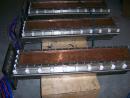
Two concentric rings of opposite-polarity permanent magnets (centre row, outer ring) sit behind the cathode, creating a closed transverse field on the target face. Electrons spiral along the field lines, trapped near the target, where they collide with the working gas (Ar) and form a dense plasma. Ar⁺ ions then sputter target atoms loose. The sputter rate is highest where the racetrack is densest — and the visible ring-shaped erosion groove forms there. A more uniform field means a wider erosion groove, higher target utilisation, and a more uniform film thickness.
Application notes
Three problems are common in practice: (1) overly concentrated field with a narrow groove — target utilisation under 30%; (2) uneven magnet demagnetisation (excess heat) creating local “burn-through” risk; (3) substrate-to-target distance not matching the field profile, producing thin edges and a thick centre. Improvements: a strong closed-field design, direct backplate water cooling (keep magnet temperature under 80 °C), and cathode length matched to substrate size. These can tighten uniformity from ±10% to ±3%.
Selection guide
Size cathode length to process area: substrate width + 100 mm as minimum effective cathode length. Pick magnet strength by target material — ferromagnetic targets (Ni, Co, permalloy) require strong-field cathodes, otherwise flux short-circuits through the target. For volume production, Horus standard models plus rotary magnet-bar kits let you swap the magnetic circuit during scheduled maintenance without opening the chamber.